
Checking Criminal History in Charlevoix County
No single search contains all Charlevoix County criminal records. Start with the event being checked. A filed misdemeanor or felony complaint belongs in MiCOURT and with the proper clerk. A very recent arrest may exist at the jail before a public court entry appears. ICHAT reaches reportable public history from across Michigan, but it omits warrants, traffic, juvenile, federal, tribal, out-of-state, suppressed, and some local misdemeanor records. OTIS covers a narrower group tied to Michigan Department of Corrections custody or supervision.
The official Charlevoix County homepage is the main path to its courts, clerk, sheriff, and forms.
Its department links help keep a request with the office that made or maintains the record.
- Identify whether the needed item is an agency report, jail booking, court file, statewide history, corrections record, or registry entry.
- Gather the full legal name, exact date of birth when permitted, spelling variants, approximate event date, and any report or case number.
- Search MiCOURT for filed cases and ICHAT for public reportable Michigan history, reading each portal's exclusions before drawing a conclusion.
- Call the jail for current custody, or contact the arresting police agency for its incident and arrest report.
- Confirm a consequential result with the District or Circuit clerk and order the official or certified record when needed.
Four Charlevoix County Record Homes
Charlevoix County records are organized by function. The arresting agency creates an incident or arrest report. The jail creates a booking and custody file. The prosecutor's authorization leads to filed charges, and the court clerk holds the docket, orders, plea, disposition, and sentence. Michigan State Police then compiles qualifying fingerprint and disposition reports in the Criminal Justice Information Center. A name can therefore appear in one system and not another without either system being wrong.
| Channel | Best use | Key limit |
|---|---|---|
| Police or sheriff | Incident and arrest narrative | Not the final court outcome |
| County jail | Booking, bond, custody, release | Booked charges can change |
| District or Circuit Court | Filed counts, hearings, disposition | One felony may span two courts |
| MSP CJIC and ICHAT | Public reportable Michigan history | Filtered scope and reporting lag |
Follow the chain instead of treating one database as a complete rap sheet. A jail allegation is not proof of guilt, and a no-record ICHAT result is not proof that no local case exists.
Michigan Official Background Checks
The Michigan State Police provides ICHAT as the public name-based route for statewide reportable criminal history. A standard search costs $10 and requires first name, last name, date of birth, gender or sex, and race. Aliases can help resolve a name change or common-name match. The product may show reportable Michigan misdemeanor convictions and felony arrests or convictions, along with related judicial data when properly reported. It does not supply warrant information or a complete national record.
MSP also explains the difference between ICHAT, a fingerprint check, and a person's own record review through its criminal-history services page.
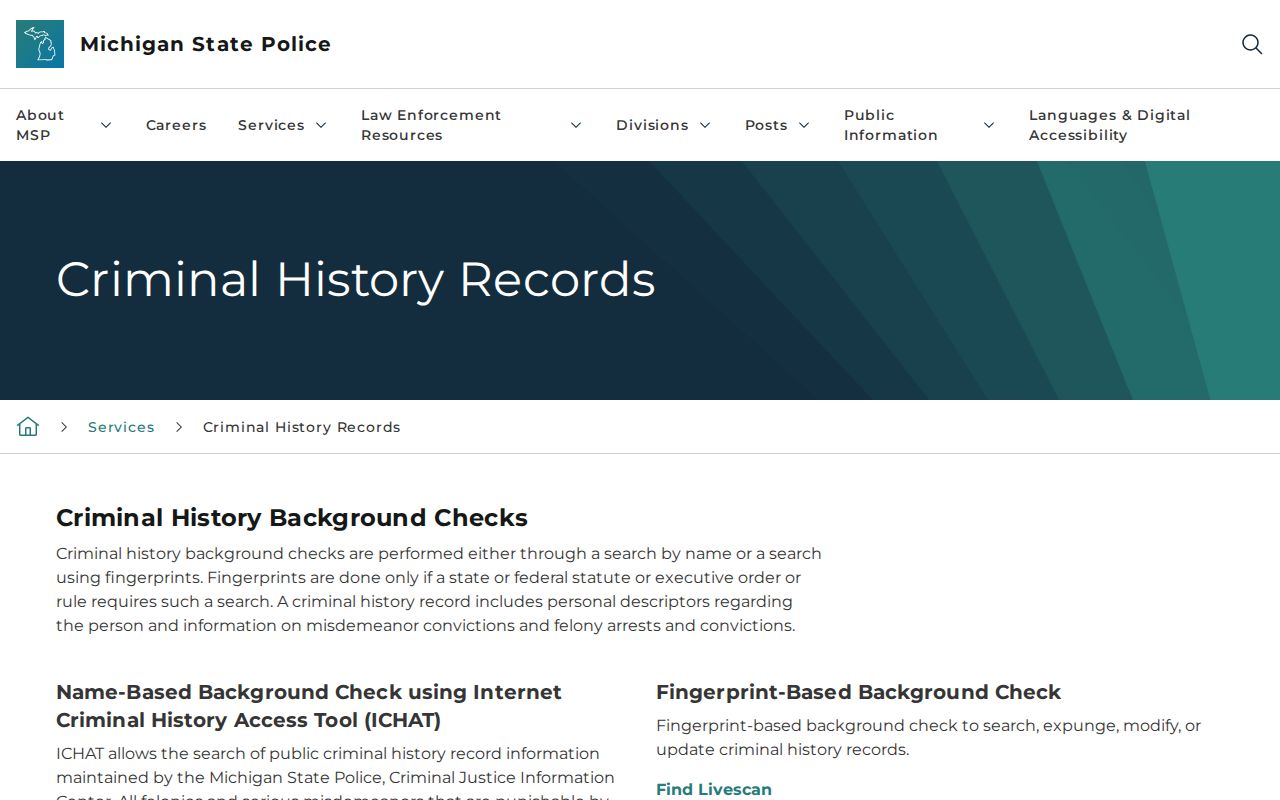
The comparison matters because fingerprints are used only when law authorizes them or when a person reviews or challenges that person's own record.
| Official product | Channel | Cost or access |
|---|---|---|
| ICHAT name search | Michigan State Police | $10 standard search |
| Authorized fingerprint check | MSP-approved Live Scan | Fees vary by legal purpose and capture site |
| MiCOURT index | Michigan trial courts | Online index is generally free |
| County copies | District or Circuit clerk | Ask about plain, certified, and archive fees |
Charlevoix County ICHAT Search Limits
ICHAT is broader than a Charlevoix County docket because it can return public reportable history from elsewhere in Michigan. It is also narrower in crucial ways. MSP excludes federal, tribal, out-of-state, traffic, juvenile, suppressed, warrant, and nonreportable local misdemeanor information. Spelling errors, missing fingerprints, and a delayed court disposition can also create a gap. Use exact identifiers and check aliases, but do not attach a common-name result to a person without enough matching facts.
Before paying, note the fields used to run the search:
| ICHAT field | Required | Use |
|---|---|---|
| First and last name | Yes | Enter legal spelling |
| Date of birth | Yes | Separates similar names |
| Gender or sex and race | Yes | Uses the subject's recorded values |
| Aliases | No | Can locate former or alternate names |
When a disposition is missing or wrong, obtain the certified court outcome first. Then follow MSP's record modification process and contact the reporting court or agency at the source.
Criminal Record Types
The phrase criminal record covers several files with different custodians and meanings. Charlevoix County police records describe an investigation. Jail records track intake and custody. Court records follow the filed prosecution. CJIC links reportable events into public state history, while probation, parole, corrections, and sex-offender systems answer narrower status questions. The distinction is most important when an arrest did not produce the charge first expected by the booking desk.
- Arrest and incident records: created by the sheriff, a city police department, MSP, or another arresting unit.
- Booking and custody records: created by the Charlevoix County Jail at intake and updated through release or transfer.
- Court case files: held by the 90th District Court for misdemeanors and felony preliminary work, then by the 33rd Circuit Court for bound-over felonies.
- State repository history: assembled by MSP CJIC from qualifying agency and court reports, with a filtered public view in ICHAT.
- Supervision and registry files: maintained through District probation, MDOC, and MSP's sex-offender systems within their own limits.
Warrants require special care. ICHAT excludes them, MiCOURT is not a complete real-time warrant tool, and Charlevoix County has no verified public warrant database. Contact the court tied to a known case and ask the sheriff for safe routing.
Charlevoix County's Two Record Buildings
One of the easiest local errors is going to the wrong building. The County Building and courthouse at 203 Antrim Street holds the District and Circuit court functions. The Sheriff and Charlevoix County Jail share 1000 Grant Street. That second address is the route for sheriff reports, jail questions, and law-enforcement FOIA. A 24-hour jail does not mean the administrative records counter provides copies at all hours.
The Charlevoix County Sheriff's official page lists the mainland headquarters and the Beaver Island and Boyne Falls substations.
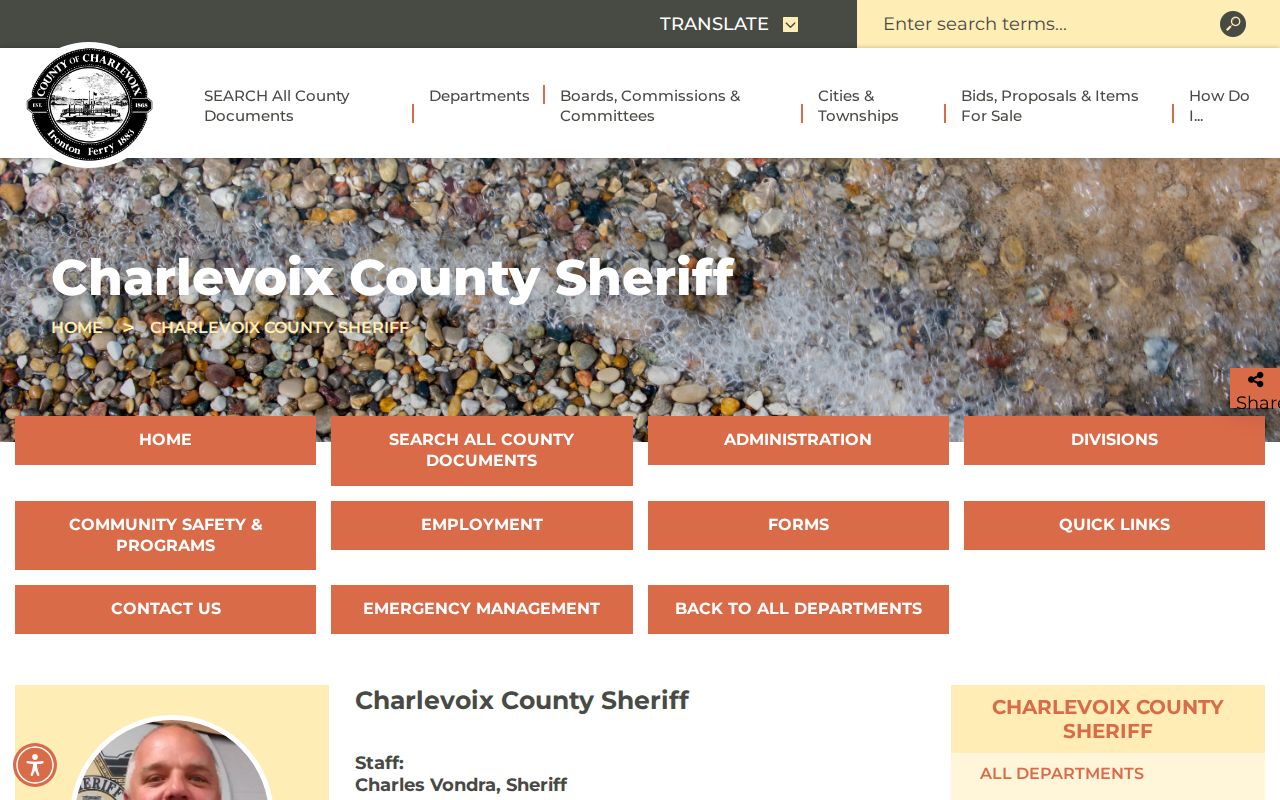
Those substations are useful access points, but the mainland jail and named record custodian still control county booking and central report requests.
County Clerk and Courts
203 Antrim Street
Charlevoix, MI 49720
231-547-7200
Sheriff and Jail
1000 Grant Street
Charlevoix, MI 49720
231-547-4461
90th District Criminal Division
203 Antrim Street
Charlevoix, MI 49720
231-547-7227
Inside a Charlevoix County Criminal Record
A Michigan criminal history is identity-centered, while a Charlevoix County court case is case-centered and a jail booking is custody-centered. Read the source label before reading the details. State history may connect aliases, descriptors, arrest cycles, and judicial segments. A docket instead organizes events under one case number. A booking file focuses on intake, holds, bond, and release authority.
| Name and identifiers | Legal and prior names, birth date, physical descriptors, and state or FBI identifiers when public. |
|---|---|
| Arrest data | Date, reporting agency, asserted charge, and fingerprint transaction details for reportable events. |
| Court charges | Complaint or information counts, statute citations, amendments, and felony or misdemeanor level. |
| Disposition | Dismissal, acquittal, plea, verdict, conviction, or other final result for each count. |
| Sentence | Jail, prison, probation, fines, costs, restitution, and other court-ordered terms when public. |
| Status | Pending, in custody, probation, parole, discharged, set aside, or nonpublic, depending on the system. |
“Bound over” means a felony moved from District Court to Circuit Court after the preliminary stage or waiver. It is not a finding of guilt. “Disposed” means the court entered an outcome, but the outcome must still be read count by count.
Charlevoix County's Two FOIA Routes
Michigan FOIA is the formal fallback when a sheriff report or booking document is not posted. Charlevoix County uses two coordinators. Law-enforcement requests go to Nathan Kaminski at 1000 Grant Street. Other county FOIA matters go to Julia Drost at 203 Antrim Street. A city-created police report should go to that city, not to either county coordinator merely because the person was later booked in the county jail.
The County Clerk's FOIA page shows this division of responsibility.
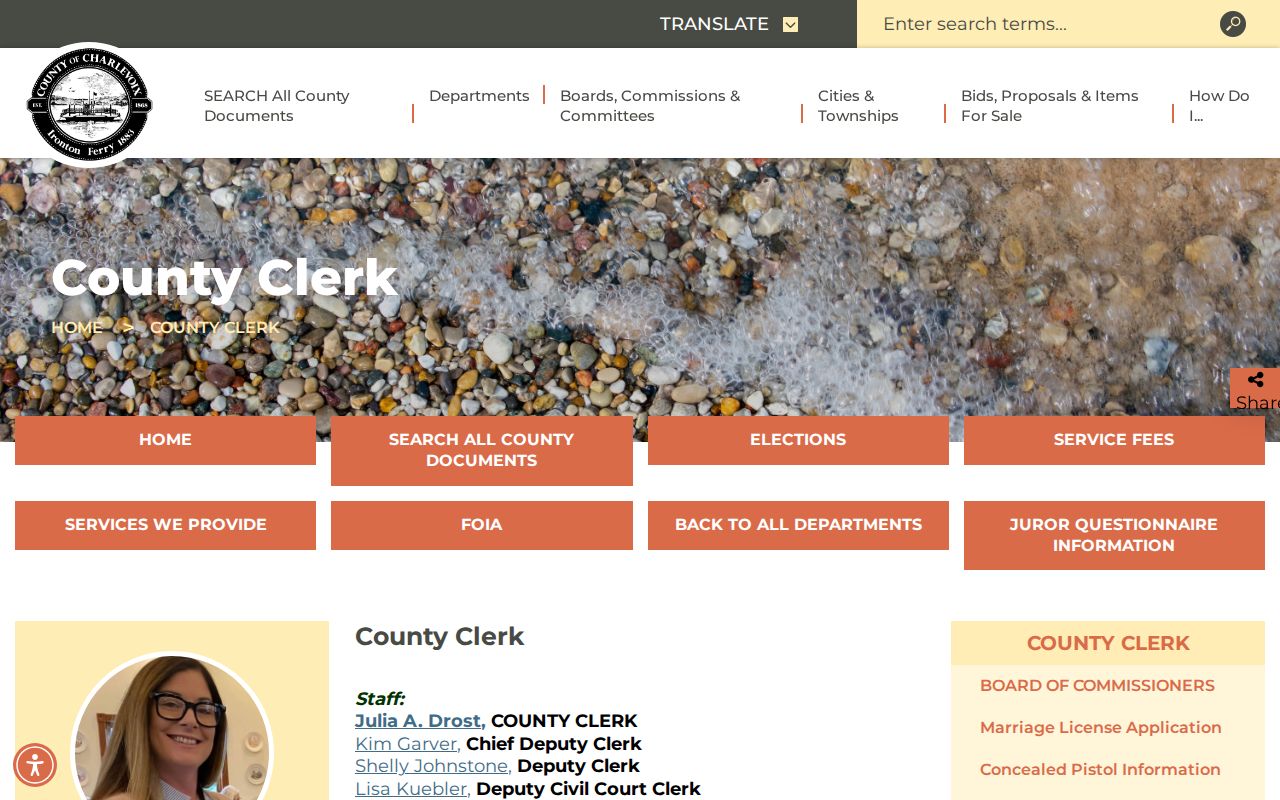
Correct routing saves time and helps the office locate the exact record without transferring the request.
Describe the incident number, date, time, place, agency, involved names, and exact product sought. Ask for electronic delivery and an itemized estimate if video, photographs, 911 audio, or broad review may add labor. Michigan FOIA generally calls for a response within five business days, with a possible notice extending the response period by up to ten business days. That deadline governs the response, not guaranteed delivery of every record.
Public Access Laws in Michigan
Public access depends on the kind of file. Michigan FOIA governs many agency records, while Michigan Court Rule 8.119 governs court files. The MSP dissemination law controls state criminal-history access. A statute, court rule, or order can still make material confidential. Active investigations, juvenile information, victim details, protected identifiers, and certain law-enforcement methods may be withheld or redacted.
Key Michigan authorities:
MCL 15.231 states Michigan's public-access policy.
MCL 15.233 provides the right to inspect or copy nonexempt public records.
MCL 28.243 governs criminal-history collection and dissemination.
Michigan Court Rule 8.119 makes the clerk's court record the official source, subject to access limits.
A FOIA request is not normally the way to order a filed criminal case. Ask the court clerk for the docket, pleadings, judgment, sentence, or certified disposition. Use FOIA for agency-created reports and releasable jail material.
Charlevoix County Jail Is Not OTIS
The county does not publish a verified official searchable inmate roster. For current Charlevoix County custody, call the jail at 231-547-4461 and use the official corrections page for current rules. Ask about custody status, booking number, charge as received, bond, next court, and release routing. Do not substitute a commercial roster or infer guilt from a booking entry.
The Michigan Department of Corrections OTIS page describes a different population.
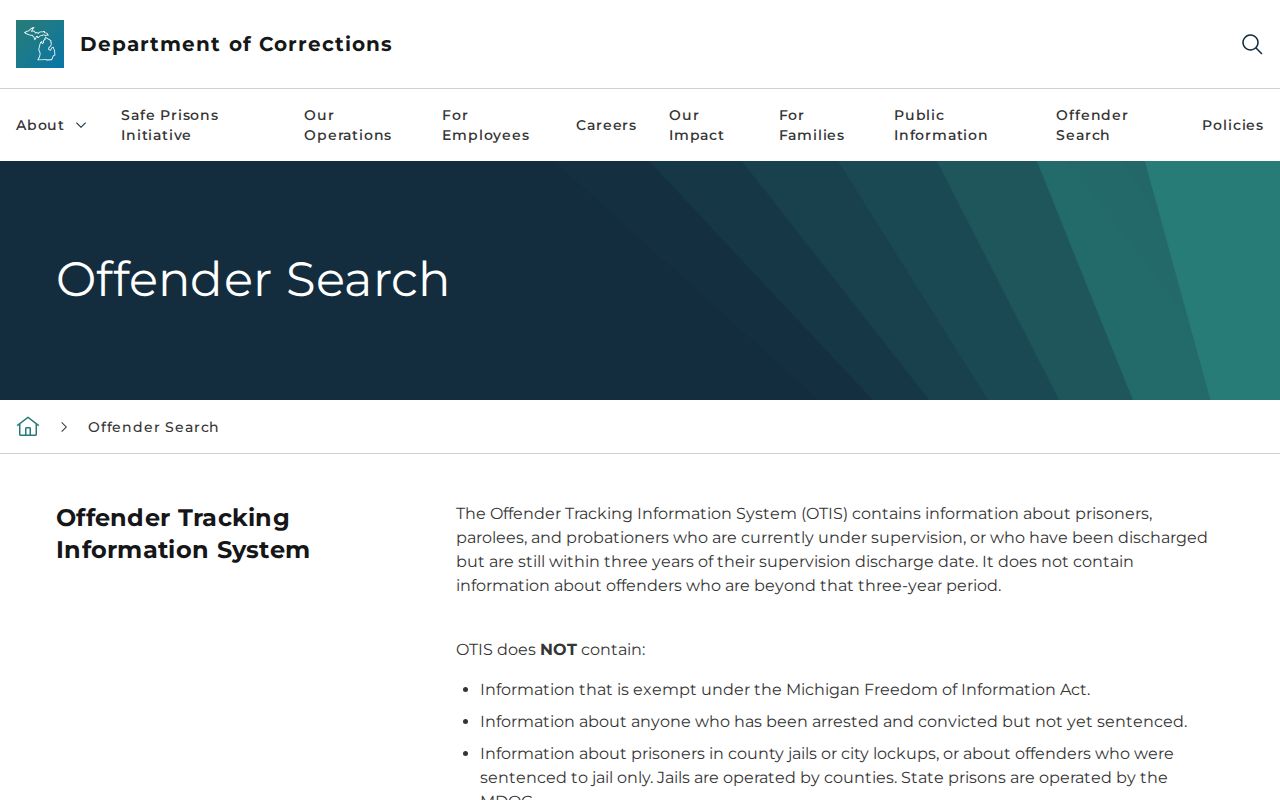
OTIS includes current prisoners, parolees, probationers, and people discharged within three years, but it does not cover county-jail-only custody.
District-court probation has its own Charlevoix County contact at 231-547-7224. Felony probationers and parolees are supervised through MDOC Field Operations in Region 2. A status shown in OTIS should be checked against the sentencing court when the question concerns the sentence itself.
Sealed, Expunged, and Restricted Records
Michigan law calls conviction relief a set-aside, while Clean Slate and expungement are common public terms. A set-aside generally makes an eligible conviction nonpublic, though courts, law enforcement, and other authorized entities can retain access allowed by law. Juvenile files, protected victim information, certain investigative material, and nonpublic registry entries also have access limits independent of a set-aside.
Application relief under MCL 780.621 and related sections depends on conviction count, offense type, waiting period, pending charges, and later convictions. The applicant obtains a certified conviction record from the court, uses current SCAO forms, follows fingerprint instructions, files in the convicting court, and sends the required notices. MCL 780.621d sets a $50 MSP processing fee. Local clerk and certified-copy costs must be confirmed with the court.
Automatic relief under MCL 780.621g began changing public results in 2023. Matching or reporting failures can leave an eligible item visible. Check both ICHAT and the county docket, then use the certified order and MSP correction channel if an entry remains.
Charlevoix County Charges Change Path
Every local felony starts in the 90th District Court. The District Court handles the complaint, arraignment, bond, and preliminary examination or waiver. A felony bound over for trial then receives a 33rd Circuit Court file. This is why one event can produce a police report number, jail booking number, District case number, and Circuit case number. Searching only Circuit Court can miss the early stage, while searching only District Court can miss the final plea, verdict, and sentence.
The Charlevoix County Prosecuting Attorney page describes the office that reviews police referrals and authorizes charges.
The prosecutor's filed count can differ from the charge first entered at booking, so the court outcome controls the final case reading.
For a focused view of filed counts, hearings, and outcomes, use the Charlevoix County criminal court case search. An arrest without a filed case may still leave an agency or booking record.
Charlevoix County Criminal Records by City
Boyne City, Charlevoix, and East Jordan are the county's three largest incorporated cities by the 2020 Census. Each city police department creates its own incident and arrest reports, but none operates a separate municipal court. City ordinance and misdemeanor matters go to the 90th District Court. A felony begins there and can move to the 33rd Circuit Court. Custodial bookings ordinarily route to the county jail.
The Boyne City government page is the official starting point for its local departments.
Boyne City police reports remain city records even when a booking and court file continue at county offices.
The East Jordan city website identifies its local government and police channel.
East Jordan readers may find phone and electronic requests useful because the county-seat custodians are in Charlevoix.
Boyne City Criminal Records
3,816 residents in 2020. City reports can lead to county booking and District Court records.
Charlevoix Criminal Records
2,348 residents in 2020. City police, county courts, and the jail use three separate counters.
East Jordan Criminal Records
2,239 residents in 2020. City reports route to the same county court system.
Charlevoix County Police Report Routing
Start a police-report request with the agency that handled the event. Charlevoix Police, Boyne City Police, East Jordan Police, the sheriff, and MSP each retain their own reports. A city arrest can require two requests: one to the city for the narrative and one to the sheriff for the jail booking. Ask separately for CAD or 911 material, body-camera files, photographs, and report supplements because each item can have different review and redaction needs.
The CCE Central Dispatch public-safety directory lists the local agencies and contact routes.
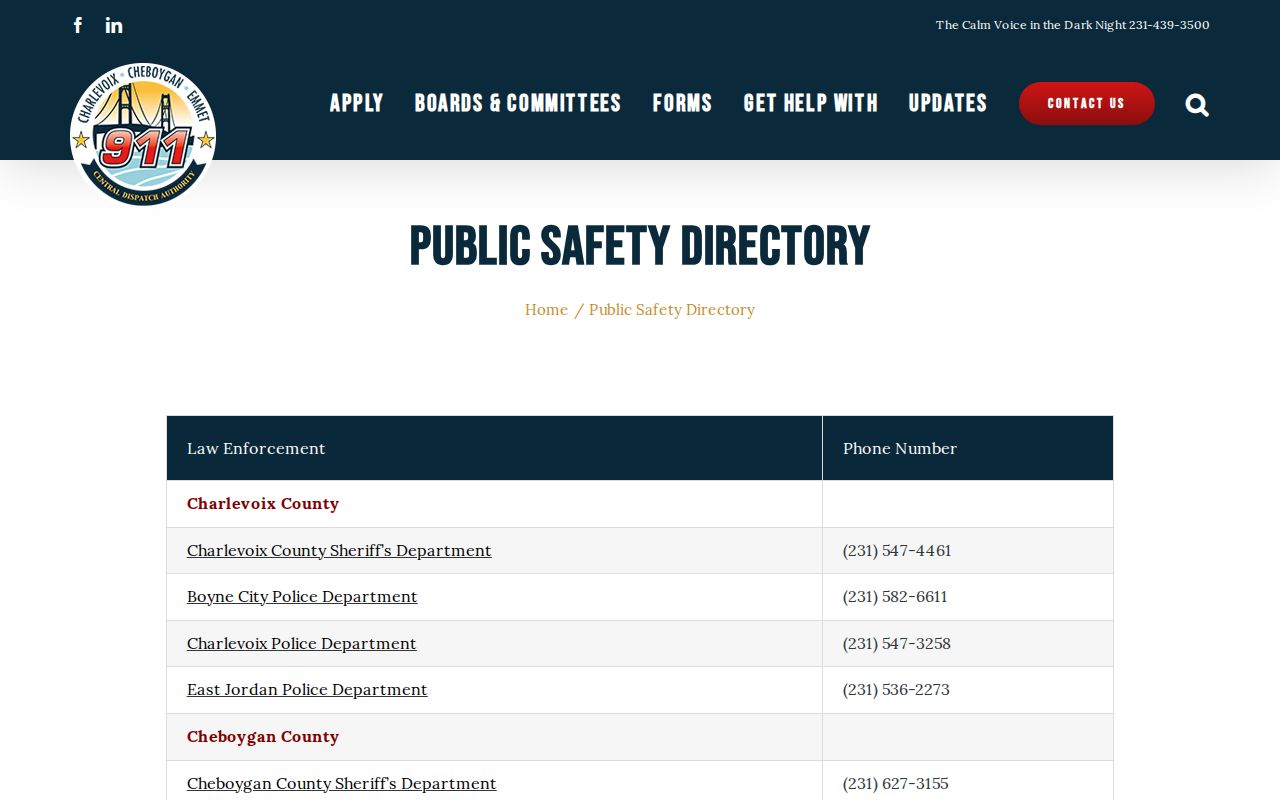
The directory helps identify the right report creator before a request is sent.
For current custody or a recent booking, the jail remains the direct source. For what happened after charging, use MiCOURT and the clerk. For state public history, use ICHAT later, allowing time for fingerprints and disposition reporting.
Charlevoix County Record Terms
Short docket labels can hide important differences. Reading them in plain terms prevents an arrest, transfer, or final result from being confused with a conviction.
- Arraignment
- The hearing where charges and rights are stated and a plea may be taken.
- Disposition
- The final court result for a charge, such as dismissal, acquittal, or conviction.
- Bindover
- The transfer of a felony from the 90th District Court to the 33rd Circuit Court.
- Bond
- Security and conditions set by the court to support release and return.
- Set aside
- Michigan relief that makes an eligible conviction nonpublic, subject to statutory exceptions.
- Parole
- Conditional community release from an MDOC prison sentence, distinct from county probation.
A dismissal ends a count without conviction. It does not by itself prove that every police or booking copy has vanished. Check the court file, ICHAT, and the source agency when correcting an old record.